


Master's degree

The master’s degree programme integrates in the fundamental field of Engineering Sciences, the field of graduate studies of Electronic Engineering, Telecommunications and Information Technology, the branch of science of Electrical Engineering, Electronics and Telecommunications. The teaching language is English.
The programme is mainly addressed to the graduates of a bachelor’s degree programme in the fields of Electronic Engineering, Telecommunications and Information Technology, Computers and Information Technology, Automation and Applied Informatics, Electrical Engineering and Computers and Computer Science, but can also be attended by graduates of similar study programmes.
The master’s programme will ensure the acquisition of skills and competencies for a professional / research career in the design and implementation of cyber security at organizational, local, national and regional level. The training of cybersecurity specialists will be based on the presentation of the concepts of cybersecurity, critical infrastructure, information security and the acquisition of practical skills in determining cyber security threats, risks and vulnerabilities and the rapid and efficient management of systems in the event of security incidents. We are the first university in the country to offer a master’s programme called Cyber Security with a content that meets the requirements of a modern and highly computerized society.
Perspectives after graduation
Specialists in the field of Science and Engineering, specialists in Information and Communication Technology. Although the occupation of Cyber Security Engineer is not yet defined in the Romanian Classification of Occupations (COR), the evolution towards an information-based society with internet and related technologies, connectivity and the enforcement of 4.0 Industry requires specialists in this field.
UNITBV–HES-SO Cyber Security Double Degree Master’s Programme
Starting with the 2026–2027 academic year, the Cyber Security master’s programme will offer students the opportunity to obtain a double degree.
The programme is developed in partnership with HES-SO – University of Applied Sciences and Arts Western Switzerland, the largest university of applied sciences in Switzerland. Under this agreement, selected students will be able to obtain two internationally recognised master’s degrees: one awarded by Transilvania University of Brașov and one awarded by HES-SO.
Applicants interested in the programme will first take part in the regular admission process for the Cyber Security master’s programme during the July 2026 admission session. They will be able to express their interest in the double degree programme during the oral examination by completing a dedicated form.
Following the admission competition and based on the applicants’ admission averages, eligible candidates will be nominated for the 10 places available to UNITBV students for the 2026–2028 study cycle. The nominated candidates will be informed about the steps required for admission to HES-SO and will participate in an additional selection interview during the September 2026 admission session.
The interview will be conducted by a joint admission committee consisting of academic staff from both universities. The committee will decide which candidates are admitted to the double degree programme and which candidates are placed on the waiting list.
Selected students will be enrolled simultaneously at UNITBV and HES-SO. The programme includes one semester of academic mobility at the partner university in Switzerland, during the second semester of the first year of study.
During the second semester of the second year, which is dedicated to the preparation of the master’s dissertation, students will benefit from joint supervision by two academic coordinators: one from UNITBV and one from HES-SO.
All teaching activities carried out in Romania and Switzerland will be conducted in English. The degree awarded by HES-SO will be available in both French and English.
Participation in the double degree programme does not involve any additional tuition fees. Mobility costs will be covered through the **Erasmus+ programme**, while the partner university, HES-SO, will provide accommodation for students in Lausanne, including coverage of any additional accommodation-related costs.
During the first year of implementation, the programme will include 10 students admitted by UNITBV and 10 students admitted by HES-SO. The number of participants may be reassessed in the following years, depending on the level of interest and the further development of the programme.
The partnership brings together the complementary expertise of the two institutions in the field of cyber security. HES-SO is recognised for the applied nature of its education and research programmes, while the coordinator of the master’s programme on behalf of the Swiss university is involved in the organisation of Black Alps, one of the most important cyber security events in the Alpine region.

The master’s programme Advanced Electrical Systems, taught in English, integrates in the field of studies Electrical Engineering and has a 2-year duration (120 credits).
The programme ensures advanced studies in order to develop students’ skills for a professional career, but also for scientific research capacities as a prerequisite for doctoral studies.
The general objective of the master’s programme is to train specialists with competencies in the field of Electrical Engineering at European level, meeting the needs of highly qualified human resources required at local and national level by the specialized economic, service, design and research units, with perspectives for national and international collaboration.
Perspectives after graduation: Occupations considered by the master's programme: design engineer for electrical systems; maintenance engineer; energy manager; researcher in the fields of renewable energies, energy management, electrical measurements.

The master’s degree field which this study programme falls into is Electronic Engineering, Telecommunications and Information Technology. The duration of studies is 2 years (120 ECTS credits). Students acquire skills for a professional / research career in the interaction of the science and technology branches of electronics, digital communications and computer engineering. At the same time, the aim is training the abilities to manage and transform the study or work context to new, unpredictable demands that require new strategic approaches in the dynamic situation of technology in programmed electronics, with extensions to digital communications as well. The completion of this study programme enables graduates to approach several professions in the field of electronic engineering and telecommunications.
Perspectives after graduation: Electronics Designing Engineer, Communications Designing Engineer, Communications Researcher, Communications or Electronics Researching Engineer, Computer-Aided Designing Specialist, Project Manager, Computer Network Administrator, Software System Engineer, Fixed and Mobile Telecommunications Network and Service Operator, ICT Service Integrators, Equipment Manufacturers Telecommunications, System Integrators, Integrated SW Solution Developers
Syllabus
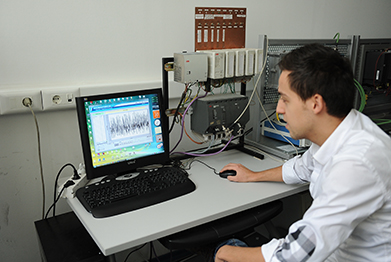
The master’s degree field which this study programme belongs to is Systems Engineering. The duration of studies is 2 years (120 ECTS credits).
The following skills are to be developed in students:
- to model, configure, design and implement structural components (hardware and software);
- to study and use digital image processing and shape recognition techniques;
- to analyse and design intelligent control systems;
- to be familiar with and use digital communications systems.
Perspectives after graduation: Employment in the economic and social environment of Brașov region, which needs specialists trained in the field of automation and information technologies. Also, national demands far exceed today’s offer of specialists. A list of potential employers could comprise IT&C and Automatics companies and organizations: Siemens Romania, IBM, Oracle, Microsoft, Route 66, STS, Romtelecom, ABB, PSI Control, Cuadripol, Rolem, Ina Schaeffler, NTT Data, Mondly, Stabiplan, etc. Students are expected to have the qualities and skills to excel in the development / application of automated systems, software and communications, in research, teaching or business in the studied fields.
